The $700 billion AI paradox: why 90% of companies see zero impact

An NBER study dropped last week that should make everyone stop and think. Researchers surveyed nearly 6,000 executives across the US, UK, Germany, and Australia. The finding: 90% of firms reported AI had zero measurable impact on employment or productivity over the past three years. Not "some impact." Not "less than expected." Zero.
Meanwhile, Big Tech is collectively spending $660 to $690 billion on AI infrastructure in 2026 alone. Amazon announced $200 billion in AI capex and promptly watched $450 billion evaporate from its market cap in ten trading days. That was the worst losing streak Amazon stock has had since 2006.
Something doesn't add up. Either the executives are wrong, or the spending is wrong. Or this is something economists have seen before.
You can see AI everywhere except in the productivity statistics
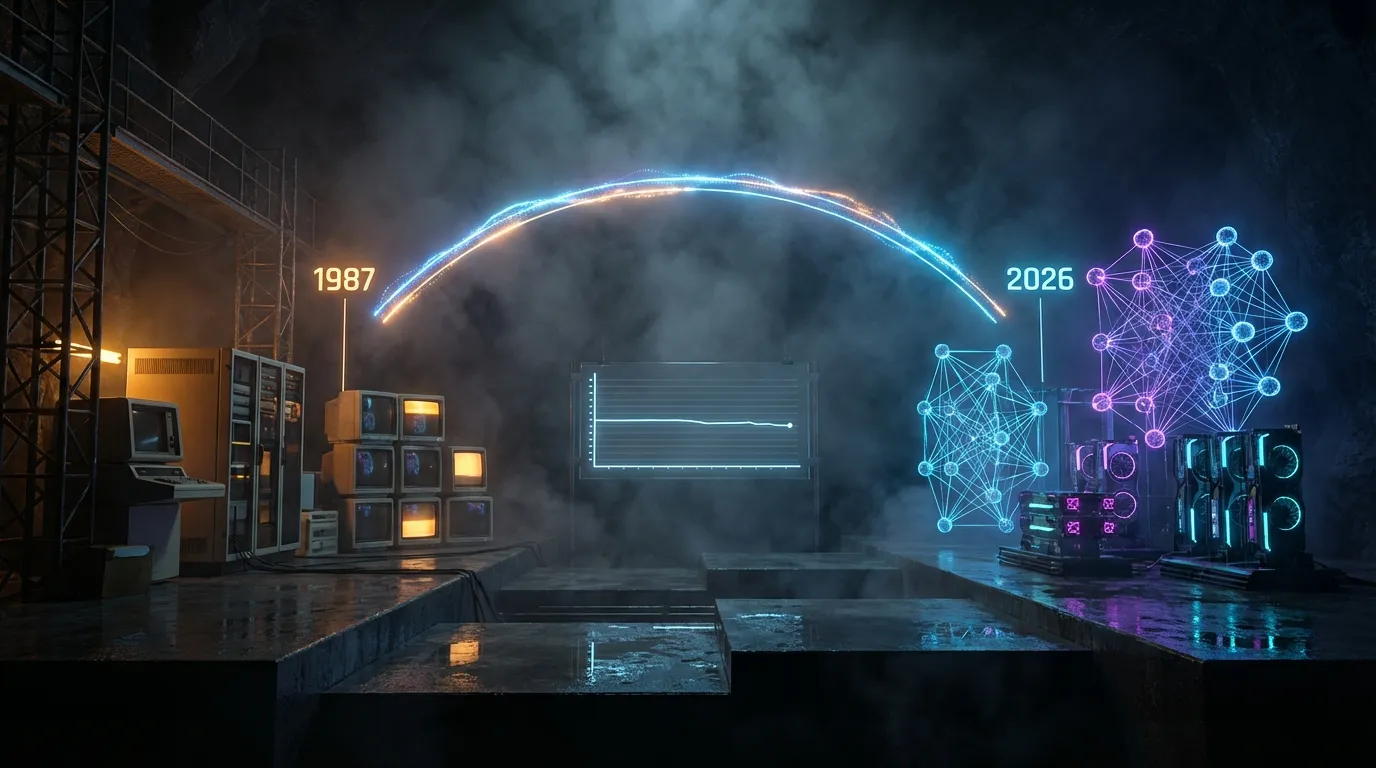
In 1987, Nobel laureate Robert Solow wrote a line that became famous: "You can see the computer age everywhere but in the productivity statistics." Companies were buying mainframes, PCs were appearing on every desk, and IT budgets were exploding. But productivity growth had actually slowed from 2.9% (1948-1973) to 1.1% after 1973.
Apollo Global Management's chief economist Torsten Slok recently echoed the same observation for AI: "AI is everywhere except in the incoming macroeconomic data." No signal in employment data. No signal in productivity figures. No signal in inflation rates.
The NBER study puts numbers on it. About 70% of firms say they're "using AI." But top executives spend an average of 1.5 hours per week with the technology. A quarter report zero personal usage. That's the gap between adoption as a checkbox and adoption as a workflow change.
The prisoner's dilemma eating $700 billion
This is where it gets uncomfortable. The five biggest spenders (Amazon, Alphabet, Meta, Microsoft, and Oracle) are projected to spend $660 to $690 billion on AI infrastructure this year. Amazon alone committed $200 billion, roughly $50 billion more than analysts expected.
Morgan Stanley estimates Amazon will hit negative free cash flow of $17 billion in 2026. Bank of America puts the deficit at $28 billion. The investments hit the balance sheet today; the revenue comes... eventually.
Why spend anyway? Because none of them can afford to be the one who didn't. If Google builds the infrastructure and Amazon doesn't, Amazon loses AWS market share. If Amazon builds and Google doesn't, same story in reverse. Game theory calls this a prisoner's dilemma. Everyone spends because not spending is worse.
NVIDIA reports Q4 earnings on February 25. The company has guided for $65 billion in revenue, a 67% year-over-year increase. Whisper numbers on Wall Street suggest anything under $67 billion will disappoint. This earnings report is essentially a referendum on whether the spending spree continues or cools.
Where AI actually works (and where it doesn't)
Gartner predicts 40% of agentic AI projects will be scrapped by 2027. Not because the models fail, but because organizations can't operationalize them. The pattern is consistent: AI works when you hand it a constrained problem with clear inputs and outputs. It falls apart when you jam it into an existing workflow without rethinking how that workflow operates.
Industries where AI is producing measurable results (tech, finance, professional services) have seen 3x higher revenue-per-employee growth than less-exposed sectors. But those are industries where the work is information processing. A law firm using AI for contract review makes sense. A manufacturing plant deploying AI because the board said to? That's where the 90% zero-impact number comes from.
The NBER study also found something interesting about expectations. Despite seeing no impact so far, executives still expect AI to boost productivity by 1.4% and increase output by 0.8% over the next three years while reducing employment by 0.7%. That translates to about 1.75 million jobs across the four countries surveyed.

The computer paradox resolved itself. Will AI?
I keep going back to one detail that changes the whole picture: the computer productivity paradox did eventually resolve. From 1995 to 2005, productivity growth surged by 1.5 percentage points. It took roughly 20 years from widespread PC adoption to measurable macro-level impact. The lag wasn't the technology being useless. It was organizations needing to restructure around the technology.
Erik Brynjolfsson (one of the researchers behind the original productivity paradox work) calls this the "J-curve." Productivity initially dips as organizations invest in reorganization, training, and new processes. Then it climbs sharply when the new workflows mature.
If AI follows the same curve, we're in the dip right now. The spending isn't wasted; it's early. But "early" and "$700 billion" in the same sentence should give anyone pause.
What this means if you're building with AI
- Don't confuse infrastructure with impact. Having an AI budget doesn't mean having AI results. The companies seeing real gains are the ones redesigning processes, not just adding AI to existing ones.
- Watch NVIDIA earnings on Feb 25. If guidance disappoints, it signals the spending cycle is decelerating. If it beats, expect another year of aggressive capex.
- The Buffett signal matters. Berkshire is sitting on $320 billion in cash while the Buffett Indicator sits at 220%. That's historically one of the loudest "be careful" signals in markets.
- AI works best in constrained domains. IT operations, code review, document processing, customer support. If you're deploying AI somewhere, start with the narrowest possible use case.
- 1.5 hours/week tells you everything. If executives are touching AI for 90 minutes a week, it's not part of their workflow. It's a thing they check on between meetings.
Computers took 20 years to show up in the productivity data because nobody wanted to rethink how work actually gets done. They just put a PC on every desk and kept filing things the same way. AI is stuck in the same phase. The $700 billion question is whether the rethinking happens before the money runs out.
References:
- Thousands of CEOs just admitted AI had no impact on employment or productivity -- Fortune
- Amazon loses $450B as $200B AI bet spooks investors -- TechBuzz
- Big Tech set to spend $650 billion in 2026 as AI investments soar -- Yahoo Finance
- NVIDIA Q4 2026 earnings preview -- TradingView
- AI adoption: from hype to enterprise reality -- TechCrunch